Subjective Root Cause Analysis
Description:
The subjective Root Cause Analysis (RCA) tools are used to systematically identify and subjectively weigh the correlation of the inputs (x’s) to the problem, Y.
Objective:
Determine the most important known and hidden root causes (when data is not necessarily available) to analyze their importance and relationships in the ANALYZE phase. These tools take all the controllable inputs (causes), and filter them down to the vital few that have the most impact on closing the gap written in the project contract.
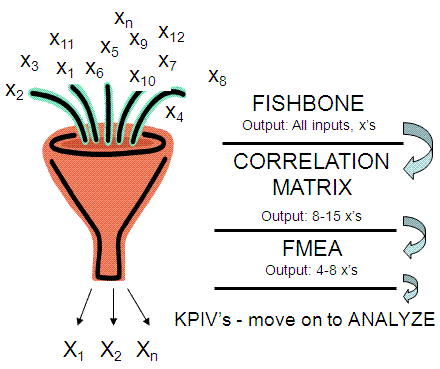
Use these tools in this order, if there are few x’s then the Correlation Matrix can be skipped. Each tool narrows the focus to the primary inputs, x’s, to the problem. The primary inputs, x’s, are referred to as the Key Process Input Variables, KPIV’s.
1) FISHBONE – includes all inputs, x1, x2, x3, x4, ……..xn.
2) CORRELATION MATRIX – also called Cause/Effect Matrix and Prioritization Matrix
3) FMEA – Failure Mode and Effects Analysis
There are often times when not all data can be gathered for a number of reasons, the data may be flawed, or there are hidden causes that need to be discussed within the team. Dialogue and knowledge sharing between the team members helps understand and weigh the impact root causes have on the output.
One helpful and simple procedure to help a team drill down to the root cause is the 5-WHY tool. This is used to drill down and reveal the root causes of unplanned downtime, form errors, injuries and accidents, quality defects, late deliveries, and more.
Another common root cause analysis tool is called the 8D which stands for the Eight Disciplines of Problem Solving (not covered here)
There are several methods to help find the root causes of variation. These are more traditional tools that are commonly used in problem solving techniques due to the ability to break complex problems into small scopes and make them manageable so everyone can participate.
The goal is to capture all of the inputs, big or small.
Narrow them down throughout the subjective tools and scoring system and take the final few key inputs (KPIV's) and begin to ANALYZE them.
Problem solving techniques, such as A3, include subjective root cause tools, process mapping and value stream mapping, and most importantly emphasize clear understanding of the problem, gap, corrective action, and accountability to control.
A3 is a key component of Toyota problem solving process that applies to all levels of the workforce. The Plan-Do-Check-Act (PDCA) cycle is fully encompassed in this simple tool. The entire scope of the cycle from problem statement all the way to completed improvements are handwritten on one large sheet of paper.
Click here to see an example A3 and its construction.
Caution
The subjective tools are important since they bring out dialogue and information that isn't necessarily found in the data. The team members and stakeholders closest to the process know the details behind the data.....and they know what the data isn't saying.
Your job, as a Six Sigma Project Manager, is to mine and correctly interpret the data and show the team the results. The team members will provide the practical (reality) discussion around it. You're not expected to have the answers yourself. But you are expected to be a effective Project Manager too.
However, this dialogue and interaction between team members can make it very time consuming to finish these tools. And you should not complete them yourself. That could lead to incorrect assessments and lose the trust of your team members.
The dialogue between team members can also lead to some arguments and disagreements on scores. You'll need to funnel that energy into positive momentum and be prepared to be the tie breaker. This is your job as a leader and Project Manager.
When the team is struggling to assign a score with consensus, you may be able to help them by showing them data in various ways and categories.
If there is too much tension among team, you may need to assess the Stakeholder using the Stakeholder Analysis tool or simply remove/replace a person.
Be careful determining the quantity of x's and y's that are analyzed in the Prioritization Matrix. This can make a significant difference in the amount of time it takes to complete this tool. This is the most time consuming of the three tools so be ready to muscle through it.
These subjective tools become even more important if there is a lack of data or poor data that simply cannot be used. Just be prepared to move quickly and be a referee. Keep the discussion limited without being too restrictive.
Don't forget to take breaks, incorporate some humor, take care of your team, but most importantly get it done.

Link to the newest Six Sigma Material
Six Sigma Templates, Tables, and Calculators


Site Membership
Click for a Password
to access entire site
Six Sigma
Templates & Calculators



Six Sigma Modules
The following are available
Click Here
Green Belt Program (1,000+ Slides)
Basic Statistics
Cost of Quality
SPC
Process Mapping
Capability Studies
MSA
Cause & Effect Matrix
FMEA
Multivariate Analysis
Central Limit Theorem
Confidence Intervals
Hypothesis Testing
T Tests
1-Way ANOVA
Chi-Square
Correlation and Regression
Control Plan
Kaizen
MTBF and MTTR
Project Pitfalls
Error Proofing
Effective Meetings
OEE
Takt Time
Line Balancing
Practice Exam
... and more