
Kano Model
Description:
The Kano Model is used to visually model the customer provided characteristics versus the level of satisfaction each characteristic delivers. It is a product development and customer satisfaction tool that categorizes customer preferences.
This tool's creation is credited to Dr. Noriaki Kano, a professor of quality management at the Tokyo University of Science. He published the tool in April 1984 as a product development and customer satisfaction theory and a set of tools and techniques to categorize the Voice of the Customer (VOC).
This tool is used after gathering the Voice of the Customer (VOC) phase. It is often used in with Quality Functional Deployment (QFD) within a DMADV (or DFSS) project and sometimes in the Define phase of a DMAIC project. It helps define where the product, process, or service is relative to the customer and the competition.
It is an indicator of customer satisfaction but is unable to tell an organization when a customers expectations have changed whether risen or reduced.
Objective:
Gather the customer "voice" to deliver the most satisfying product, process, or service. The information is gathered using various techniques, but the participants should be the customer or those as closest to the customer and end user as possible.
Often these techniques are in the form of a questionnaire, surveys, interviews, review of feedback, social media, and review of warranty claims.
The tool is used to assist teams prioritizing functionalities they believe will delight the customer.
Categories within the Kano Model
Dr. Kano developed 5 categories to classify the customer preferences. Several variations of the Kano Model exist along with definitions of the categories. Generally the categories are:
The Kano Model is a graphical display showing the relationship between each characteristic to the level of customer satisfaction. It's used to organize and prioritize activities to design and/or improve.
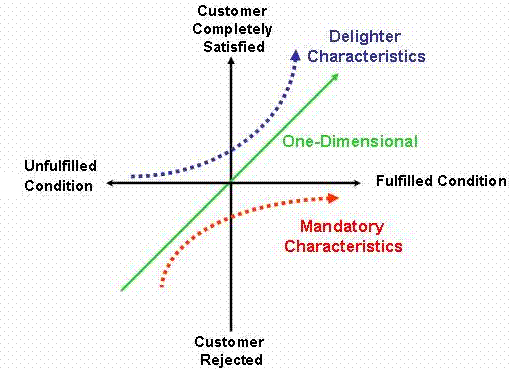
The x-axis ranges from the a product, process, or service that has failed or has broken completely.
The y-axis ranges from a completely unsatisfied feeling to the most satisfied customer.
To find out which characteristics deliver on which level of satisfaction it is necessary to develop a questionnaire, interview, use focus groups, conduct research or otherwise find the customer stated specific characteristic and its expected level of satisfaction.
Then each point is plotted on the chart using a scale that is up to the team to develop (should be linear).
NOTE:
For a DFSS (DMADV) project, these customer criteria (aka CTQ's) are taken to the Pugh Matrix for further numerical evaluation to determine how well each of the proposed design options meets these criteria of the Voice of the Customer.
Kano Model Dynamics
Each Kano Model should be kept and saved with a specific date and notes regarding each decision making process. Customer demands and expectations change over time resulting in new models and revisions.
Typically, over time the Delighter features become Mandatory characteristics. The innovation of product features becomes an expectation for future releases or revisions.
The idea is to develop a perfect product, process, or service that delivers optimal customer satisfaction and keeps them coming back.
However, the focus is more on the product features rather than the customer needs. Sometimes the customer may not know what they "want" or "need" until they know what features can be provided.
Avoid making assumptions on behalf of the customer. Use tools such as interviews and surveys to capture the most accurate customer feedback.
This is the reason that the Kano Model is most often used in DMADV or DFSS Six Sigma projects instead of DMAIC. DMAIC Six Sigma projects are centered around improving an existing process rather than a new product, process that needs development.
Example of the dynamics of potential customer needs:
A house built in 1950:
Dissatisfying: poor sanitation control, broken windows, leaking roof
Mandatory Characteristic: roof, foundation, windows, fireplace
One-dimensional: Insulation, code construction, outlets, shower, lights, running water, septic/sewer
Delighters: Air conditioning, dishwasher, garage, washer, dryer, smoke alarms, ground wires.
A house built now:
Dissatisfying: squeaky floors, infestation, broken windows, leaking roof, poor sanitation controls.
Mandatory Characteristics: roof, foundation, windows, lights, insulation, code construction, toilet, shower, running water, sewer/septic, ground wires, closet space, GFCI outlets.
One-dimensional: garbage disposal, dishwasher, garage, washer, dryer
Delighters: Stainless steel appliances, security cameras, energy efficient HVAC, alarm system, pool, wine cellar, granite countertops, walk-in closet, brick pavers, landscape lighting, deck, central vacuum, wireless home controls, sprinkler system.
Templates, Tables, and Calculators
Test your knowledge with these sample certification problems
Return to the Six-Sigma-Material Home Page


Site Membership
Click for a Password
to access entire site
Six Sigma
Templates & Calculators



Six Sigma Modules
The following are available
Click Here
Green Belt Program (1,000+ Slides)
Basic Statistics
Cost of Quality
SPC
Process Mapping
Capability Studies
MSA
Cause & Effect Matrix
FMEA
Multivariate Analysis
Central Limit Theorem
Confidence Intervals
Hypothesis Testing
T Tests
1-Way ANOVA
Chi-Square
Correlation and Regression
Control Plan
Kaizen
MTBF and MTTR
Project Pitfalls
Error Proofing
Effective Meetings
OEE
Takt Time
Line Balancing
Practice Exam
... and more