|



DMAIC Project Contract
Also referred to as the Project Charter
The first step is in any DMAIC project is refining the Six Sigma DMAIC project contract. A sample project contract is shown below.
This template, and several others, is available for from the Templates page.
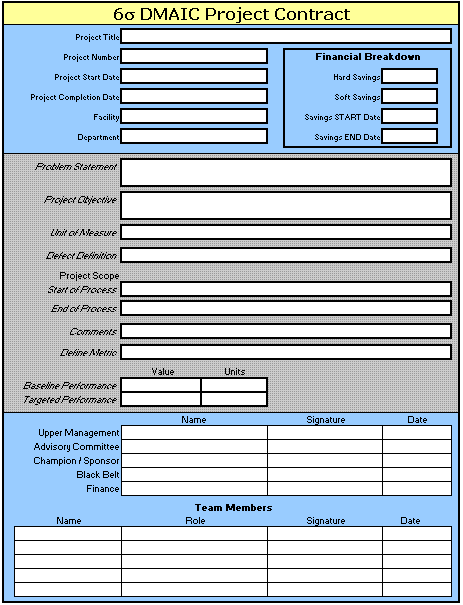
The details for completing the DMAIC project contract are shown below:
1) Project Title or Identification Number
2) Problem Statement – detail the problem to improve with numbers and time frames. Avoid bias or any indication of a solution in the statement. State only facts, refrain from opinions or subjective assumptions.
3) Business (or Project) Objective – included information should be:
Specific – detailed information on the process or customer voice.
Measurable – current and desired goal, may be more than one metric.
Attainable – within the teams control.
Relevant – aligns with company objectives.
Timely – defined start and expected completion dates.
4) Financial Quantification - should involve financial and managerial accountants along with GB, BB, and/or MBB. It is important to quantify accurately including the timing. Properly distinguishing between hard and soft savings is critical to upper management. Hard savings are defined as actual money saved or not spent as planned. Soft savings are intangible improvements such as shifting work tasks, improving customer perception, and reducing failure risks.
5) Team members – signatures, roles, and date of initiation (may not be firm at this point).
6) Process Owner – One team member that will take over control and manage the gains after the project is closed. Someone that is close to the process and willing to take on the responsibility. This person is not typically the GB/BB.
7) Champion/Sponsor – executive management leader to provide guidance for the team but limited detailed participation in team activity. The Sponsor is most likely to define the objectives for the team.
8) Scope – process boundaries to stay within while achieving objective.
9) Upper Management Approval - contract submitted to upper management and must receive their approval. Upper management may also attend this approval to address the team and elaborate on the importance and to show connectivity.
When the contract is completed, it should show a direct link from the team members, leader, GB/BB, to upper management. The team now has the autonomy to operate within the conditions of the contract.
However, contract stipulations are negotiable. Information will evolve from the teams efforts. Changes can occur within the scope, resource needs, or the objective.
It does not need to be perfect in order for the team to
start. There will likely be revisions in the DEFINE phase as the project scope and financial impact are better understood.
Project Charter
The charter is essential to ensure that ample time and thought goes into ensuring the project is achievable and viable. It should:
- Ensure the Champion is supportive and has ability to deploy resources needed
- The solution meets the company objectives and goals
- The team is focused on the appropriate problem and composed of the correct team members.
The Business Case (aka Problem Statement and Objective) is short summary of the reason for the project. It should be as detailed as possible and explain how it supports the organizational goals and objectives.
One of the reasons Six Sigma earns a bad reputation is due to far-fetched expectations and misalignment to company goals so ensure the financial savings goals, timing, and alignment are legitimate and achievable.
Make sure the team is composed of qualified people with the knowledge and expertise of the project context. This could be process owners, downstream users, customers (both internal and external), management, hourly, cross functional departments, and more.
An initial project of 4 months, or 120 days, is considered a good guideline.
Subscribe to access entire site
Return to Six-Sigma-Material Home Page
Recent Articles


-
Process Capability Indices
Oct 18, 21 09:32 AM
 Determing the process capability indices, Pp, Ppk, Cp, Cpk, Cpm
 -
Six Sigma Calculator, Statistics Tables, and Six Sigma Templates
Sep 14, 21 09:19 AM
 Six Sigma Calculators, Statistics Tables, and Six Sigma Templates to make your job easier as a Six Sigma Project Manager
 -
Six Sigma Templates, Statistics Tables, and Six Sigma Calculators
Aug 16, 21 01:25 PM
Six Sigma Templates, Tables, and Calculators. MTBF, MTTR, A3, EOQ, 5S, 5 WHY, DPMO, FMEA, SIPOC, RTY, DMAIC Contract, OEE, Value Stream Map, Pugh Matrix -
Six Sigma, Six Sigma Training, Courses, Calculators, Certification
Aug 15, 21 10:27 PM
 One site with the most common Six Sigma material, videos, examples, calculators, courses, and certification.

Site Membership
LEARN MORE
Six Sigma
Templates, Tables & Calculators

Six Sigma Slides
Green Belt Program (1,000+ Slides)
Basic Statistics
Cost of Quality
SPC
Process Mapping
Capability Studies
MSA
SIPOC
Cause & Effect Matrix
FMEA
Multivariate Analysis
Central Limit Theorem
Confidence Intervals
Hypothesis Testing
T Tests
1-Way ANOVA
Chi-Square
Correlation
Regression
Control Plan
Kaizen
MTBF and MTTR
Project Pitfalls
Error Proofing
Z Scores
OEE
Takt Time
Line Balancing
Yield Metrics
Sampling Methods
Data Classification
Practice Exam
... and more
Statistics in Excel
Need a Gantt Chart?